

Curriculum in the early childhood setting means all the interactions, experiences, activities, routines and events – planned and unplanned – that occur in an environment designed to foster children’s learning and development.
— adapted from Te Whāriki, the New Zealand Curriculum Framework
 Philosophy
The Nursery and Weekday School was established in 1949 as an outreach of the church to offer young children in the community opportunities to grow as thinking children, who discover the world around them with creativity and curiosity, capable children who work with other children and adults to solve problems together, caring children who learn to share themselves and materials with others, contented children who enjoy learning, and loving children who are being loved, respected and challenged in a safe and secure environment where they have fun. We hope that by providing this atmosphere and these experiences, our school will help prepare children to become people who respect others, value diversity, and will be active, contributing members of their communities in the future.
Young children of all ages need a variety of stimulating experiences in order to support their growth and development. Our developmental approach to early childhood means that we welcome each child as they come to us, guiding and supporting their physical, social, emotional and cognitive growth.
This curriculum framework is a structure that supports and responds to the emerging daily experiences of children as they learn and grow with others around them.
Young children learn by doing; they learn through their play. When children play they demonstrate what they understand, as well as what they are seeking to understand. Play is the testing ground for new theories, new ideas, and it is the way children create meaning of their experiences. Therefore, PLAY is at the center of our curriculum framework. So that we may make meaning of children’s play and support their critical learning with intention, we employ the following Principles, Practices and Learning Outcomes.

Our practice draws from numerous pedagogical approaches including Reggio Emilia, Reflective Practice, Lilian Katz’s Project Approach, Vygotsky’s theories on social constructivism and scaffolding, among others.
The process of gathering information as evidence about what children know, can do, and understand is part of an ongoing cycle that includes planning, documenting and evaluating children’s learning. Through relevant and meaningful authentic assessment, we give value to the children’s thinking which enhances their learning.
Learning outcomes – skills, knowledge and dispositions – are encouraged and supported in collaboration with children and families.
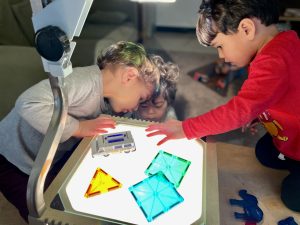 Children learn and construct knowledge through meaningful experiences that build interest, motivation and a love for learning. We plan experiences and projects that match children’s interests, learning styles and developmental needs.
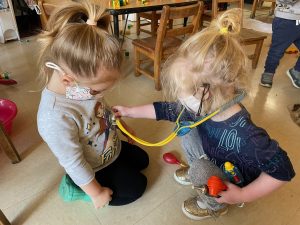 We use the children’s interests as a basis for our curriculum. By observing and listening to the children we are able to identify what they want to learn more about: babies, peacocks, worms, shadows or anything else that captures their interest or imagination.
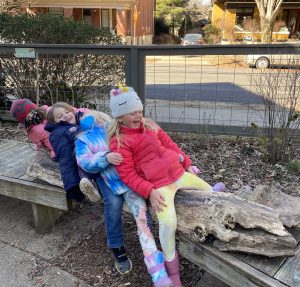 We consider relationships to be the foundation of everything we do at HPCNWS. Our relationships with children and families are based on respect and the belief that children are competent and capable.
 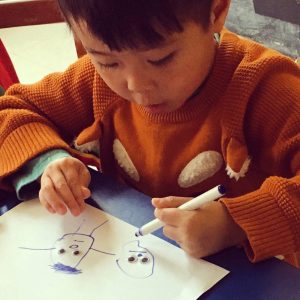 Children thrive when school and families work together in partnership to support young children’s learning. We strive to create a welcoming environment where all children and families are respected and encouraged to collaborate with teachers and staff to ensure that learning experiences are meaningful and supported at school and home. Sharing family culture, cooking, reading books, and singing are just a few examples of how parents have partnered with and been a part of the curriculum.
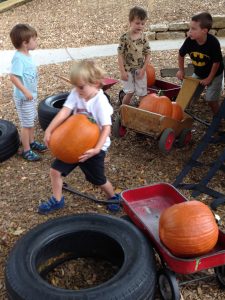 Play is critical to children’s learning so we offer large blocks of time for children to explore, create, imagine and concentrate. During this time children develop problem-solving and critical thinking skills. To assist children in their play, activities and materials are provided in our dramatic play, block, science, sensory, manipulatives and literacy areas in the classroom as well as in our outdoor play spaces.
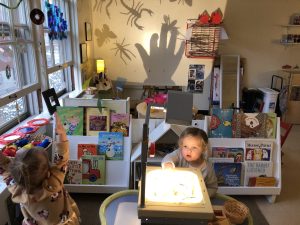 The Reggio Emilia approach considers the environment to be the third teacher. Carefully arranged spaces for children foster creativity, clear communication, and strong relationships. We are inspired by this approach and believe children learn from attractive and interesting materials provided in an organized and thoughtful manner. We maintain a variety of materials or “loose parts” to use on a rotating basis or to extend an idea emerging from children’s play. Most of these materials are open-ended, allowing children to decide how to use them.
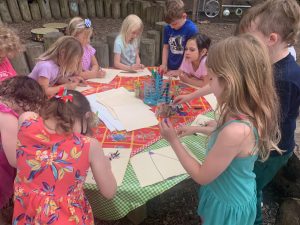 Learning is meaningful when it is responsive to how young children learn. It is important when planning experiences for the group and for individual children that we learn who they are and what interests them. We do this by listening to the children as they play, observing them, designing experiences according to their needs and interests, and documenting their work. This gives value to the children’s thinking and enhances their learning.
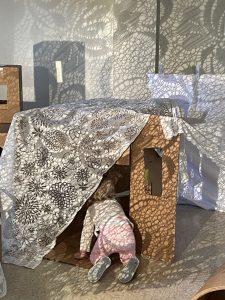 Intentional teaching is “to always be thinking about what we are doing and how it will foster children’s development and produce real and lasting learning.” (Epstein, 2007) We do this by making informed decisions based on the children’s interests, child development, developmentally appropriate practice and by individualizing experiences to support each child’s unique development. By observing – planning – doing – reflecting – and changing as needed – we act purposefully.
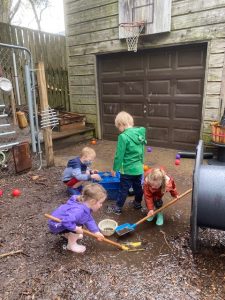 We believe that when children are engaging in meaningful experiences, it’s important for them to have uninterrupted TIME to make choices, solve problems, interact with and respect others, and learn together with the adults around them in an unhurried, peaceful environment. We balance times children make choices on their own with times they work collaboratively with a group. Through these experiences, children and adults learn from each other.
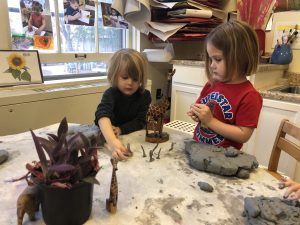 Children develop dispositions for learning such as curiosity, cooperation, confidence, creativity, enthusiasm, persistence and imagination. They increasingly are able to take responsibility for their own learning, self-regulation and social contribution.
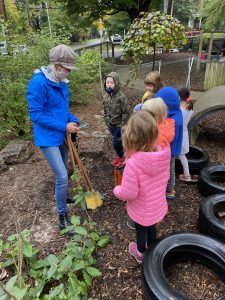 Children feel safe and supported which can be seen in their secure attachments with teachers and peers, the ability to initiate and join in play, to cooperate and work with others and increasingly self-regulate in a variety of circumstances.
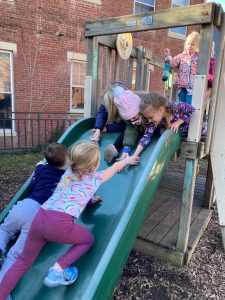 Children have a sense of belonging and comfort in their environment which is demonstrated when they help others, relate to others respectfully, and mutually share ideas with others.